


Blackout Curtains for West-Facing Rooms — Block Heat, Glare & UV All Afternoon

Why West-Facing Rooms Are the Hardest to Control
- • From 2–6 PM, west-facing windows receive direct, low-angle sunlight that ordinary curtains cannot stop. Glare hits screens at the worst possible angle — rooms become unusable during peak hours.
- • West-facing glass acts as a solar collector, pushing indoor temperatures 8–12°F higher than the rest of the home. Air conditioning runs constantly but can't keep up, driving summer energy bills up significantly.
- • Intense afternoon UV degrades furniture, flooring, and upholstery up to 3× faster than shaded rooms. Visible fading begins within months of direct exposure.
- • Room-darkening curtains using chemical blackout coating fail the west-facing test — coatings degrade over time, and even 1–5% light transmission creates visible hot spots and ongoing UV damage. True 100% physical blackout is the only reliable solution.
Physical Blackout — Built for the Harshest Afternoon Exposure
- Urban, Gary, and Todd curtains achieve 100% light blocking through physical triple-weave construction — zero chemical coating, zero off-gassing, certified OEKO-TEX Standard 100. Performance stays consistent wash after wash, year after year.
- At 320 GSM (Urban herringbone) and 270 GSM (Gary linen), these fabrics create an insulating air gap between curtain and glass that measurably reduces solar heat gain. Independent studies show properly installed blackout curtains lower room temperature by up to 33%.
- Custom-made to your exact dimensions — up to 240 inches wide and 360 inches tall — every panel extends beyond the window frame to eliminate the edge light leakage that defeats off-the-shelf options. If you measure wrong, we'll remake at half price.
- Physical UV blocking protects furniture and flooring from photo-degradation without sacrificing aesthetics. Urban's narrow herringbone weave, Todd's clean minimalist texture, and Gary's double-sided linen look all work in modern and transitional interiors.
West-Facing Blackout Curtains — Physical Blocking Only
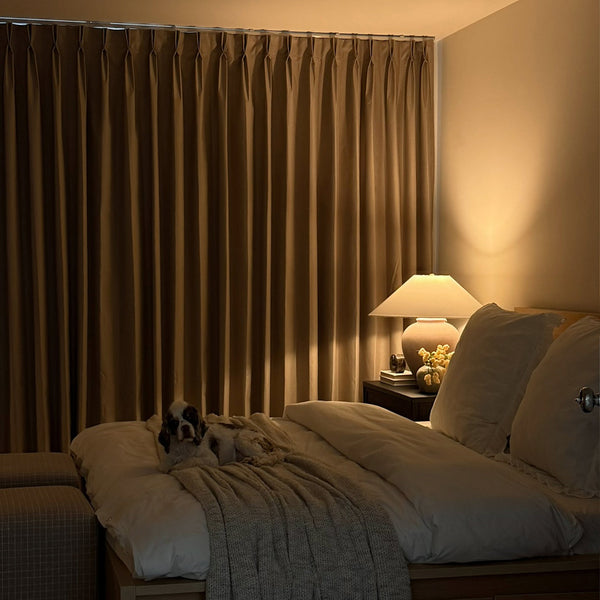
Urban 100% Blackout Narrow Herringbone Curtains
- ✓ Triple-layer physical blackout
- ✓ Narrow herringbone texture
- ✓ Solar heat reduction up to 33%
- ✓ OEKO-TEX certified
- ✓ Zero chemical off-gassing
- ✓ Made-to-measure precision fit
From $116.85
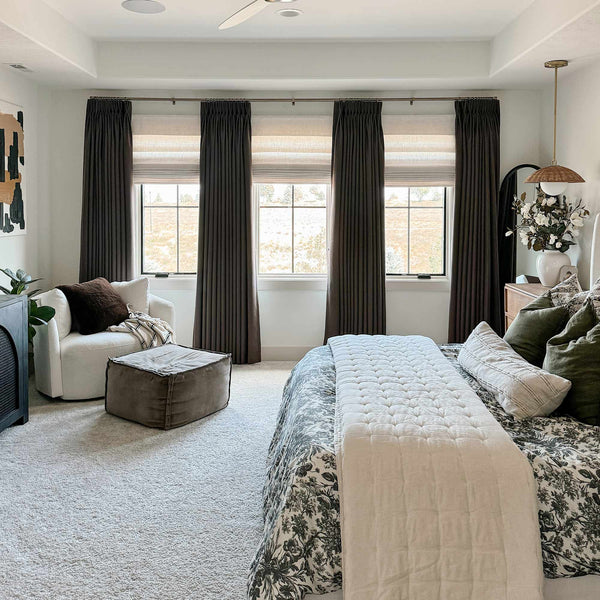
Gary Linen Look 100% Blackout Curtains
- ✓ Double-sided linen texture (both faces identical)
- ✓ Physical blackout — no coating
- ✓ OEKO-TEX Standard 100 certified
- ✓ Memory-shaped draping
- ✓ Machine washable
From $75.14

Todd 100% White Blackout Curtains
- ✓ 358 GSM heavier weight
- ✓ Linen-texture surface
- ✓ Memory-shaped — holds pleats
- ✓ Zero light gap when properly installed
- ✓ Machine washable
From $113.51
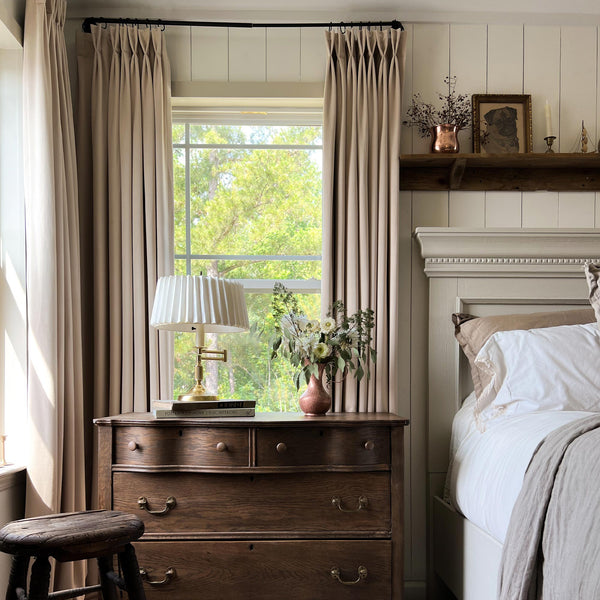
Elma Soft Blackout Velvet Curtains
- ✓ 420 GSM heavy velvet drape
- ✓ Excellent thermal insulation
- ✓ Best for rooms that don't require 100% blackout
- ✓ Natural sound absorption
- ✓ Machine washable
From $108.53
5 Steps to Eliminate West-Facing Heat and Glare

West-Facing Installation Checklist
-
Mount Wide: Extend 6–10 Inches Beyond the Frame on Each Side
West-facing sun enters at a low angle and exploits any gap at the curtain edges. Mounting 6–10 inches wider than the window on each side ensures complete coverage when closed. For windows wider than 60 inches, extending 10–12 inches per side provides additional protection against edge creep as the sun angle changes throughout the afternoon.
-
Mount High: Ceiling Height or 4–6 Inches Above the Frame
The top light gap is the most common failure point in west-facing blackout installations. Ceiling-mounted or near-ceiling rods eliminate this gap entirely. Taller drops also create a larger fabric-to-glass air gap, improving thermal insulation performance — at Curtarra, we recommend floor-to-ceiling panels for any room where heat reduction is a priority.
-
Choose Pinch Pleat or Neat Pleat Heading
Structured pleat headings pack fabric into tighter, deeper folds that reduce light penetration at the curtain top. Eyelet and ripple fold styles leave wider gaps between fabric and rod when closed — avoid these for west-facing applications where edge sealing is critical.
-
Layer with a Sheer on a Double Rod for Daytime Flexibility
A double rod system gives complete control: sheer layer on the outer rod for morning and early afternoon light, blackout layer on the inner rod closed from 2 PM onwards when west-facing sun peaks. This approach prevents the room from being completely dark during usable morning hours while maintaining full heat and glare protection during peak afternoon exposure.
-
Use Our Free Measurement Tool Before Ordering
West-facing windows often require precise oversizing to achieve zero light gaps. Use Curtarra's free online measurement tool to calculate the exact rod width, panel drop, and fabric fullness for your specific window dimensions. If you measure incorrectly, our Size Assurance policy covers a remake at half price.
West-Facing Homeowners on the Difference
Why Physical Blackout Outperforms Chemical Coating for West-Facing Rooms

Physical Blackout — No Chemical Coating

Up to 33% Solar Heat Reduction

Custom Made to Eliminate Every Light Gap

Size Assurance — Remake at Half Price If You Measure Wrong
Frequently Asked Questions
Everything you need to know about blackout curtains for west-facing rooms — from heat reduction performance to installation specs and ordering.
Do blackout curtains actually reduce heat in west-facing rooms?
Yes — significantly. West-facing windows are the primary source of afternoon solar heat gain in most homes. Studies show properly installed blackout curtains reduce solar heat gain by up to 33%, translating to a measurable temperature drop. Three factors determine performance: fabric density (Urban at 320 GSM and Gary at 270 GSM both create an insulating air gap), installation width (extending 6–10 inches beyond the frame eliminates edge heat ingress), and mounting height (ceiling or near-ceiling installation closes the top gap). At Curtarra, we recommend floor-to-ceiling panels for any west-facing room where heat reduction is the primary goal.
What's the difference between physical blackout and chemical coating blackout curtains?
Physical blackout curtains achieve light blocking through multilayer woven fabric construction — no added chemicals. Chemical coating blackout curtains apply an acrylic or foam backing to standard fabric to block light. The practical differences: chemical coatings crack and degrade over 2–4 years of washing and UV exposure, eventually allowing light through. Physical construction maintains performance indefinitely. Chemical coatings also off-gas VOCs — a concern in enclosed rooms. Curtarra's Urban, Gary, and Todd collections use physical construction and carry OEKO-TEX Standard 100 certification, confirming the absence of harmful substances.
How wide and long should blackout curtains be for a west-facing window?
For west-facing applications, extend your curtain panels 6–10 inches beyond the window frame on each side, and mount the rod 4–6 inches above the frame (or at ceiling height). This ensures fabric covers the full wall opening when closed, eliminating the edge light leakage that undermines narrower installations. For total panel width, add the two side extensions to your window width, then order that total dimension as your finished curtain width. Use Curtarra's free measurement tool at curtarra.com/pages/measurement-tool to calculate exact dimensions for your window.
Will blackout curtains stop my furniture from fading?
Yes — when closed during peak sun hours. UV radiation in west-facing afternoon light is the primary driver of accelerated furniture, flooring, and upholstery fading. Physical blackout curtains block the UV wavelengths responsible for photo-degradation, not just visible light. The key is consistent use: closing blackout curtains from approximately 2 PM (when west-facing sun peaks) until sunset provides comprehensive UV protection for your interiors. Many customers report visible fading halted completely after switching to Curtarra physical blackout panels.
Can I have natural light in the morning and blackout in the afternoon?
Yes — a double rod system achieves this effectively. Mount your Curtarra blackout curtains on the inner rod (closest to the wall) and a sheer or light-filtering panel on the outer rod. In the morning and early afternoon, keep the blackout layer open and enjoy filtered daylight through the sheer. Close the blackout layer from around 2 PM to manage the afternoon west-facing sun. This layered approach is what we recommend for west-facing living rooms and home offices where daytime usability matters. The Sandra cotton-linen sheer pairs particularly well with Urban or Gary for this purpose.
How long does it take to get custom blackout curtains from Curtarra?
90% of Curtarra orders ship within 2 weeks of order confirmation. Custom sizing for west-facing windows — including oversized panels up to 240 inches wide — falls within the standard production window at no extra charge. If your order involves specific fabric combinations or special heading configurations, lead time may extend to 3–4 weeks. Free fabric swatches ship immediately (just $3.99 for shipping) so you can confirm your color and texture while your production slot is scheduled.
Related Blackout & Light Control Guides

How to Fix Light Leakage in Blackout Curtains
Already have blackout curtains but still getting light through the edges? This guide identifies the five most common light leakage points in installed curtains and explains exactly how to fix each one — from side gaps to top light bars.

Blackout Curtains for Floor-to-Ceiling Windows
Large glass panels present specific sizing and installation challenges for blackout performance. This guide covers panel width calculations, heading selection, and how to achieve zero light gaps across extra-wide window spans.

Blackout Curtains and Winter Insulation: Do They Help?
The same physical construction that blocks west-facing summer heat also provides measurable winter insulation. This guide examines the thermal performance data and explains how to maximize energy savings with curtain layering through all seasons.


