


Total Blackout for Home Theaters — French Return Rods, Ceiling Mount & Valances

Why 'Blackout' Curtains Still Ruin Your Home Theater
- • Standard blackout curtains cover the glass — but leave four light entry points that destroy picture quality in a dedicated viewing room. Side gaps at the wall edge (between curtain and wall) let in bright slashes of ambient light that your eyes adjust to, washing out dark scene contrast.
- • Top gaps between the curtain rod and the ceiling or ceiling trim admit the most light per square inch — a 2-inch gap at ceiling height is eye-level with seated viewers and creates a constant light bar across the top of your field of vision.
- • Bottom gaps where panels hang 1–2 inches above the floor allow light from adjacent rooms or hallway traffic to bleed under the curtain and reflect off light-colored flooring directly toward the screen.
- • Over-window mounting (rod placed directly above the window frame rather than near the ceiling) shrinks the effective blackout zone — sunlight enters above the curtain top through the wall section between rod and ceiling, angling downward into the room.
The Four-Layer Light Seal — How to Get True Blackout
- French return rods curve the curtain end back to the wall surface, eliminating the side gap entirely. The curtain wraps around the rod return and lies flat against the wall — zero light path from the edge. For wall-to-wall coverage of an entire home theater wall, two panels on a single return rod with sufficient fullness achieves complete side seal without center gap.
- Ceiling mount or ceiling-flush install puts the rod bracket at ceiling height or directly into the ceiling surface, closing the top gap completely. Combined with a custom Jolie valance that extends from ceiling to rod level, the transition is light-tight and adds a finished theatrical look.
- Floor-pooling panels (add 2–4 inches beyond measured floor height when ordering) create a soft fabric seal at the bottom — fabric lying on the floor blocks all under-curtain light leak. For rooms with smooth floors, a 1-inch break is sufficient; for carpet, 2 inches prevents the panel from riding up.
- Wall-to-wall coverage (rod width = full wall width, not just window width) ensures light from windows at any angle cannot enter through the side walls. In a dedicated home theater, covering the full wall rather than just the window is the professional installation standard.
6-Step Home Theater Blackout Installation Guide

Installation Checklist
-
Step 1: Use a French Return Rod — Seal the Side Gaps
A French return rod curves 90° back to the wall so the curtain wraps the end and lies flat against the wall surface — zero side light path. Specify a return depth equal to your bracket projection (typically 3–6"). When ordering panels, add twice the return depth to your total width so fabric reaches the wall on both sides.
-
Step 2: Mount at Ceiling Height — Close the Top Gap
Place brackets within 1" of the ceiling surface rather than above the window frame. For rooms with crown molding, mount below the molding and let the Jolie valance bridge the gap. Use Curtarra's free measurement tool to calculate the exact drop from ceiling to floor before ordering.
-
Step 3: Add a Jolie Valance — Finish the Ceiling Transition
A Jolie valance mounted at ceiling height hides the rod hardware and covers any remaining gap between panel tops and ceiling. Its structured top edge sits flush to the ceiling; the 18–24" drop covers the rod completely. Order to match your full rod width — wall-to-wall valance width eliminates top-corner light leak.
-
Step 4: Order Panels with Floor Pool — Seal the Bottom
Add 2–4" beyond your ceiling-to-floor measurement when ordering. This creates a soft floor pool that blocks under-curtain light bleed. Smooth flooring: 2" pool. Carpet: 3–4" to prevent hem from riding up with airflow. Specify ceiling-to-floor measurement + pool allowance as your finished panel length.
-
Step 5: Cover Full Wall Width — Not Just the Window
Extend the rod and panels to cover the entire wall, not just the window opening. Low-angle sunlight enters through angled paths that window-width coverage misses. Curtarra makes panels up to 240" wide — one or two panels can cover a complete home theater wall with no center seam.
-
Step 6: Choose Pinch Pleat Heading — Pack the Fabric Tight
Pinch pleat packs fabric into dense folds that reduce light penetration at the curtain top and create a tighter fabric stack when closed. Avoid eyelet and ripple fold in home theaters — they leave wider gaps between folds. Pinch pleat also allows panels to close flush against the wall return.
Recommended Products for Total Home Theater Blackout
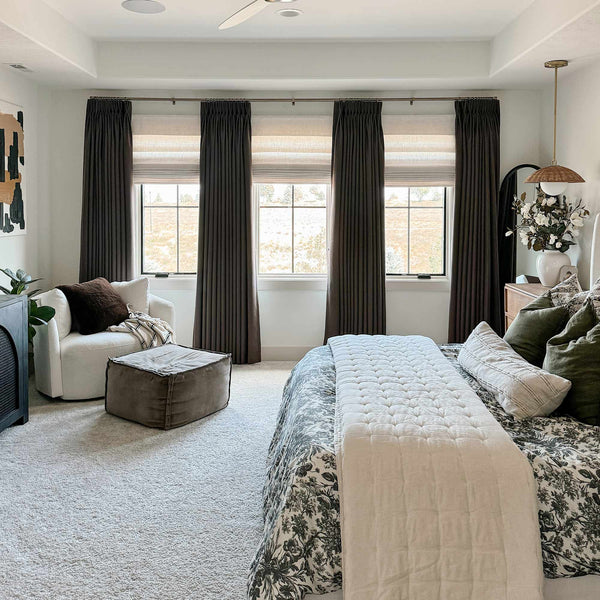
Gary Linen Look 100% Blackout Curtains
- ✓ 100% physical blackout — triple-weave, zero chemical coating
- ✓ Double-sided linen texture (back as clean as front — great for French return)
- ✓ OEKO-TEX certified — no off-gassing in enclosed theater room
- ✓ Machine washable — low maintenance in high-use rooms
- ✓ Memory-shaped draping — panels hang straight without pinning
- ✓ Custom to 240" wide for full-wall coverage
From $104.46
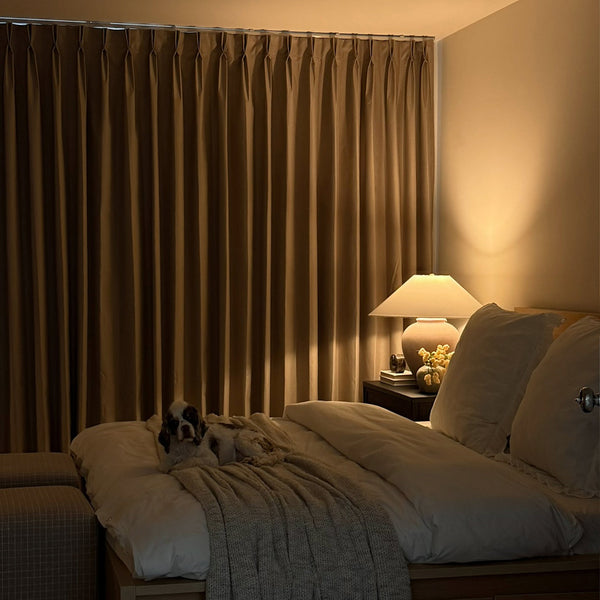
Urban 100% Blackout Narrow Herringbone Curtains
- ✓ 320 GSM — heavier drape holds position better when closed
- ✓ Narrow herringbone weave — high-end textile look
- ✓ Physical blackout — zero coating degradation over time
- ✓ Superior thermal insulation — keeps theater room temperature stable
From $162.44

Jolie Toile De Jouy Patterned Flat Valances
- ✓ Classic Toile De Jouy retro pattern — quaint romantic aesthetic
- ✓ 3 colorways: faded yellow, muted blue, subdued black
- ✓ Hard lining for structured flat silhouette — holds shape at ceiling line
- ✓ Board mount or rod mount — adapts to ceiling-flush installations
- ✓ Soft muted retro tones coordinate with Gary's linen and Urban's herringbone
- ✓ Custom width — order to match your exact rod or wall width
From $220.21
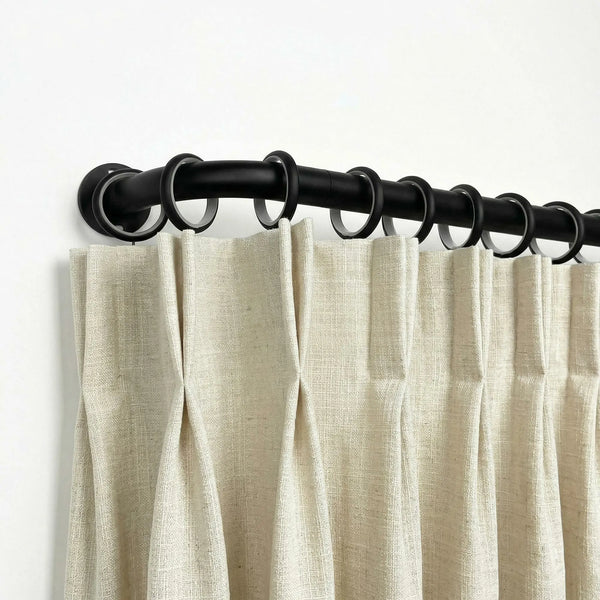
Max Custom French Return Curtain Rod
- ✓ Wrap-around returns curve fabric all the way to the wall — zero side light gap
- ✓ Max weight capacity: 44 lbs — handles heavy blackout panels
- ✓ Custom width up to 82" — specify your exact wall span
- ✓ 4½" U-shape returns on both sides, compatible with pinch pleat heading
- ✓ Optional silent glide rings (1 per 4" of rod width + 2 extra for returns)
- ✓ Rustproof electroplated iron · Mounting accessories included
- ✓ 3-year warranty — free replacement if product fails
From $247.45
Why Curtarra for Home Theater Blackout

Custom Width to 240" — True Wall-to-Wall Coverage

Double-Sided Construction — French Return Installs Look Intentional

No Chemical Coating — No Off-Gassing in Enclosed Rooms

Specify Exact Floor Pool — Order Once, Install Right
Home Theater Owners on Achieving True Blackout
Frequently Asked Questions
Technical answers about French return rods, floor pooling calculations, valance use, and choosing between Gary and Urban for your home theater installation.
What is a French return rod and why does it matter for home theaters?
A French return rod (also called a wrap-around curtain rod) has curved end sections that bend 90° back toward the wall, allowing the curtain panel to wrap around the rod end and lie flat against the wall surface. This eliminates the side light gap that standard straight rods leave — the space between the end of the curtain and the wall edge. In home theaters, this side gap is one of the most common sources of light bleed because it runs the full height of the curtain at eye level with seated viewers. A French return rod, combined with panels ordered wide enough to wrap the return, closes this gap entirely. At Curtarra, specify your bracket return depth (typically 3–6 inches) and add twice that measurement to your total panel width order to ensure the panel reaches the wall surface.
Should I cover the full wall or just the window for a home theater?
Full wall coverage is the professional standard for dedicated home theaters. Covering only the window leaves light entry paths above, below, and beside the window through the wall surface itself when sun angles are low (morning and late afternoon). Light from a window at a 30° angle enters above a window-width curtain and reflects off the floor toward your screen. Wall-to-wall coverage on a ceiling-height rod closes all these angle-dependent gaps. Curtarra makes panels up to 240 inches wide — wall-to-wall coverage of most home theater walls is achievable with one or two panels per side. Measure your full wall width and order panels to that dimension plus your desired fullness calculation.
How much floor pool should I order for a home theater curtain?
2–3 inches of floor pool is standard for home theater installations. This creates enough fabric contact with the floor to seal the bottom light gap without creating a trip hazard when entering the room in the dark. For rooms with plush carpet, order 3–4 inches — carpet compression means less fabric actually contacts the floor surface. For smooth hardwood or LVP flooring, 1.5–2 inches is sufficient. When ordering from Curtarra, specify your ceiling-to-floor measurement as the drop, then add your desired pool length to get your total finished panel length. Example: 9-foot ceiling to floor = 108 inches, add 2.5 inches pool = order 110.5 inches finished length.
Do I need a valance if my curtains are ceiling-mounted?
Yes — for home theaters, a valance is recommended even with ceiling-height mounting. Here's why: ceiling-mounted rod brackets create a small gap between the rod and the ceiling surface (typically 1–3 inches depending on bracket design), and the rod hardware itself reflects light from projector lens flare or ambient sources during viewing. A Jolie valance mounted at the ceiling hides both the bracket gap and the rod hardware, and creates a finished theatrical look that signals intentional design rather than functional installation. Order the valance to your exact wall width (matching your rod width) so it covers the full top edge wall-to-wall.
Gary vs Urban — which is better for a home theater?
Both achieve 100% physical blackout. The deciding factors are weight preference and aesthetic. Gary (270 GSM, double-sided linen) is lighter, drapes with a softer hand, and is ideal for French return installs because both faces look identical — the wrap-around section against the wall looks as clean as the face side. Urban (320 GSM, narrow herringbone) is heavier, holds position more rigidly when closed (important in rooms with HVAC airflow), and provides slightly better thermal insulation. Urban's herringbone weave also has a mild sound-scattering effect — a minor acoustic benefit in a theater environment. At Curtarra, we recommend Gary for French return installs and rooms where the curtain aesthetic is a priority, and Urban for rooms where static closure position and thermal performance matter more.
How do I calculate how wide to order panels for a French return rod?
Formula: (Wall width + (2 × rod return depth) + desired fullness allowance) ÷ number of panels = finished width per panel. Example for a 12-foot wall with 4 1/2 inches return depth, 2 panels, 2× fullness: total fabric needed = (144" + 9") × 2 = 306 inches. Per panel = 153 inches each. The return depth is added because each panel must wrap around one rod end — the 4 1/2 inches return section is fabric width that disappears around the bend. Use Curtarra's free measurement tool at curtarra.com/pages/measurement-tool to input your wall dimensions and it will calculate the recommended panel widths automatically. If you're unsure, our 7×24 customer service team can walk through the calculation with you before you order.
Will blackout curtains help with sound in a home theater?
Yes — meaningfully, though not as a replacement for dedicated acoustic treatment. Heavy blackout curtains (270–320 GSM) add mass to the room's reflective surfaces, reducing high-frequency flutter echo from hard walls and reducing the metallic quality of room acoustics. Urban's 320 GSM herringbone weave provides slightly more acoustic damping than Gary's 270 GSM. Full wall coverage amplifies this effect — a wall-to-wall curtain installation treats the entire wall surface rather than just the window area. At Curtarra, several home theater customers report noticeably improved dialog clarity and reduced room echo after full-wall curtain installation, particularly in rooms with hardwood floors and minimal soft furnishings.
Related Home Theater & Blackout Guides

How to Fix Light Leakage in Existing Blackout Curtains
Already have blackout curtains but still getting light edges? This guide diagnoses the five most common leakage points — side gaps, top bars, center gaps, bottom bleed, and angled light — and provides specific fixes for each without replacing your curtains.

Blackout Curtains for Floor-to-Ceiling Windows
Large glass walls present the same total-blackout challenge at larger scale. This guide covers wall-to-wall sizing calculations, heading selection for wide panels, and how to achieve zero light gaps across extra-wide glass spans.

Eliminating Screen Glare in Media Rooms
Screen glare in media rooms often comes from multiple sources beyond windows — ambient light reflection, TV backlight bleed, and room light spill. This guide covers comprehensive glare elimination for media rooms used under varied lighting conditions.


